
AI-Assisted Stakeholder Discovery: What Consultants Actually React To
The gap between explaining the concept and showing it working is enormous. What consultants actually respond to when they see Clarity First running has surprised me.
Stakeholder discovery is one of the most valuable and most time-consuming parts of any consulting engagement. Scheduling, conducting, transcribing, and synthesising 15 to 30 interviews can consume weeks of senior consultant time. The mechanics of gathering insight eat into the margins of delivering it.
That's the problem Clarity First was built to solve. It's an AI-assisted stakeholder discovery platform that automates interviews and synthesis for consultants and professional services firms. AI-conducted voice interviews, structured analytical frameworks, multi-agent synthesis, and evidence-traced reporting, delivered in days rather than weeks at a fraction of the cost of traditional approaches.
But describing what a platform does is one thing. What I've learned from demoing it over the last few weeks is that the gap between explaining the concept and showing it working is enormous. And what consultants actually respond to has surprised me.
The concept lands. The methodology gets the reaction.
When you describe Clarity First in a sentence, people understand it immediately. AI-assisted stakeholder discovery. Automated interviews. Structured analysis. They nod. They get it.
But you can also see the question forming: how is this different to recording interviews and running the transcripts through ChatGPT or Gemini? It's a fair question, and honestly it's the right one to ask. If the answer were "not much," there would be no reason for this platform to exist.
The answer only becomes clear when you show it working. And that's where the reactions start.
Purpose-driven analysis, not just AI summaries
A management consultant I showed the platform to had been following the explanation with interest. He understood what we were doing. Conceptually, it made sense.
Then we got into the demo. He watched the analysis come through and his jaw visibly dropped.
Not because AI was producing summaries. Anyone can get a summary from any number of AI tools. What stopped him was the methodology underneath.
At the start of any Clarity First engagement, you create a contextual brief and framework. You define the purpose, the scope, the questions that matter, the outcomes you're trying to understand. That brief then flows through the entire process. It shapes every question the AI interviewing agent asks. It shapes how each of the specialist analysis agents interprets what they hear. It shapes the synthesis, the recommendations, and the final reporting.
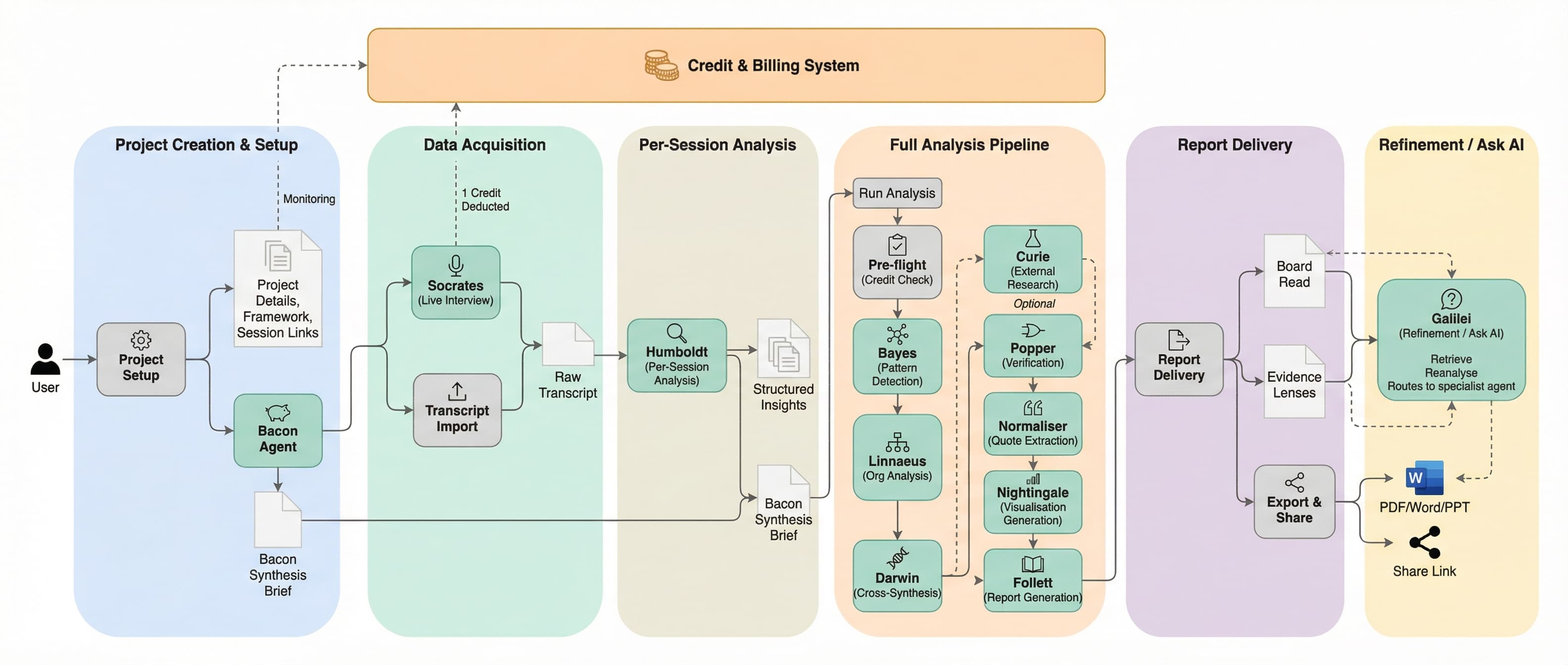
This is the critical difference between a stakeholder discovery platform and a general-purpose AI tool. When you paste transcripts into ChatGPT, you get a plausible narrative. But plausible and purposeful are very different things. Clarity First doesn't just ask "what did people say?" It asks "what did people say in the context of what we're actually trying to understand?" Structure and context are what turn AI output into genuine insight.
Every finding in the platform traces back to actual quotes with participant attribution. Not summaries of summaries, but evidence. The evidence architecture means that when a recommendation appears in your report, you can see exactly which interviews support it, what was said, and by whom. For consultants who need to defend findings to a client board, that traceability is not a nice-to-have. It's essential.
And the analysis isn't a single pass. Multiple specialist AI agents work in sequence: extracting themes and data points, detecting patterns and correlations, mapping perception gaps and organisational dynamics, synthesising findings into an executive narrative, validating against external sources, and then verifying the conclusions by challenging unsupported claims. The pipeline is structured, repeatable, and transparent.
I didn't even get to show all of this in that first demo. I hadn't yet demonstrated how you can refine and regenerate the analysis, reprompt on specific sections of the report, or manually edit before anything goes to a client. That's the "AI-augmented, not AI-powered" principle in practice. The platform does the heavy analytical lifting. You stay in charge of the output.
The speed of recognition
A second consultant, someone whose business involves early-stage discovery with clients as well as discovery with prospects further up the funnel, had a similar pattern. He got the concept immediately. When I showed the platform running, his eyes lit up. You could see him placing it into his own workflow, seeing where it would fit, understanding what it would change for his business.
We had the next meeting booked before the demo was over.
That reaction has taught me something important about who Clarity First resonates with most strongly. The people closest to the discovery problem, the ones who actually spend their weeks on the logistics of stakeholder interviews, don't need convincing about the concept. They need proof that the execution is real. Show them it works, and the conversation moves from "interesting" to "how do I use this?" almost immediately.
This aligns with what we know about the primary market for AI interview tools. Boutique management consultancies, typically 1 to 25 people, feel the margin squeeze most acutely. Discovery work is essential to what they deliver, but the mechanics of gathering and analysing stakeholder input eat into profitability. They don't have large teams to absorb the overhead. A platform that compresses weeks of discovery into days, at a cost of 60 to 100 euros per interview compared to 300 to 500 euros or more for traditional approaches, changes the economics fundamentally.
Extending existing capabilities
A third person I demonstrated to operates in a similar space, but at significantly larger scale. Analytics, data strategy, discovery. For his firm, understanding purpose before jumping into solutions isn't just best practice, it's the foundation of everything they deliver. The Clarity First philosophy of purpose-driven discovery resonated immediately.
What interested him most was what the platform could add to capabilities his team already had. Not replacing what they do, but extending it. He could see how it would help with operational delivery across multiple concurrent engagements, giving his team a structured tool for the parts of discovery that consume disproportionate time without requiring disproportionate expertise.
The combination of AI-conducted interviews with a rigorous analytical framework offered something genuinely complementary to their existing practice. For larger consultancies and internal strategy teams, this is often the more relevant framing: Clarity First as a capability layer that sits alongside what you already do, not a replacement for it.
The question people think but don't always ask
The fourth example is different, and I want to be honest about it. A consultant in a smaller practice watched the demo carefully. Thoughtful. Clearly processing what they were seeing. But the reaction was more considered than the others.
I think what I was observing was recognition combined with a question that people don't always voice: where does this leave what I do?
When you see a platform conduct 30 structured stakeholder interviews in the time it used to take to schedule 10, and produce analysis that would have taken days to compile manually, it's natural to wonder about the implications. I want to address that directly.
Clarity First is not a replacement for consultants. It is structurally, deliberately not a replacement. The interview is not where the real value of consulting lives. The value is in knowing what to ask, interpreting what you hear, connecting findings to context the data cannot see, navigating organisational politics and personality, and making recommendations that hold up when someone challenges them.
Discovery mechanics eat your time. They don't define your expertise. Clarity First handles the breadth and the logistics so you can invest your time where it actually counts: the conversations that need a human in the room, the judgement calls, the synthesis that requires experience and instinct rather than just data processing.
This is why we describe the platform as AI-augmented rather than AI-powered. You define the brief. You shape the framework. You refine the output. You decide what the client sees. The platform gives you momentum. It doesn't take your seat at the table.
Two capabilities that keep coming up unprompted
Across all of these conversations, two features have surfaced repeatedly without any prompting from me.
The hybrid model
Clarity First can run AI-conducted voice interviews at scale, but it also supports consultant-led interviews via Microsoft Teams (now built in) and can import transcripts from interviews conducted elsewhere. All sources run through the same analytical framework, the same synthesis pipeline, the same evidence architecture.
For consultants, this opens up a strategic approach to stakeholder engagement. Use AI interviews for breadth: organisation-wide participation, dispersed teams, large stakeholder groups, anyone you need to hear from but can't realistically sit down with individually. Keep the human touch for depth: board members, VIPs, change champions, sensitive conversations where presence and rapport matter. Breadth and depth in the same engagement, analysed with the same rigour.
This hybrid capability means consultants aren't choosing between AI and traditional discovery methods. They're combining them strategically, matching the approach to the stakeholder. That's a fundamentally different proposition from "replace your interviews with AI," and it's the one that consistently generates the strongest reaction.
White labelling
Nearly every conversation has included some version of "can I brand this as mine?" unprompted. Consultants don't just want tools. They want capabilities they can present to clients as their own. A branded stakeholder discovery platform, running a methodology they've configured, changes the positioning of the entire engagement. It moves discovery from "something we do manually or outsource" to "part of our integrated offering."
Clarity First supports full white labelling at Partner tier, including custom branding, multi-client workspaces, and the ability to configure bespoke frameworks. The demand for this has been stronger and more immediate than I anticipated.
Simplicity on the surface, sophistication underneath
One theme runs through all of this feedback, and it's something I care about deeply as a design principle.
People are consistently impressed by the simplicity of the experience. Setup takes 15 minutes. Participants receive a link and talk for 20 to 30 minutes. Synthesis runs in 10 to 15 minutes. Reports are ready almost immediately, exportable as PDF, Word, or PowerPoint.
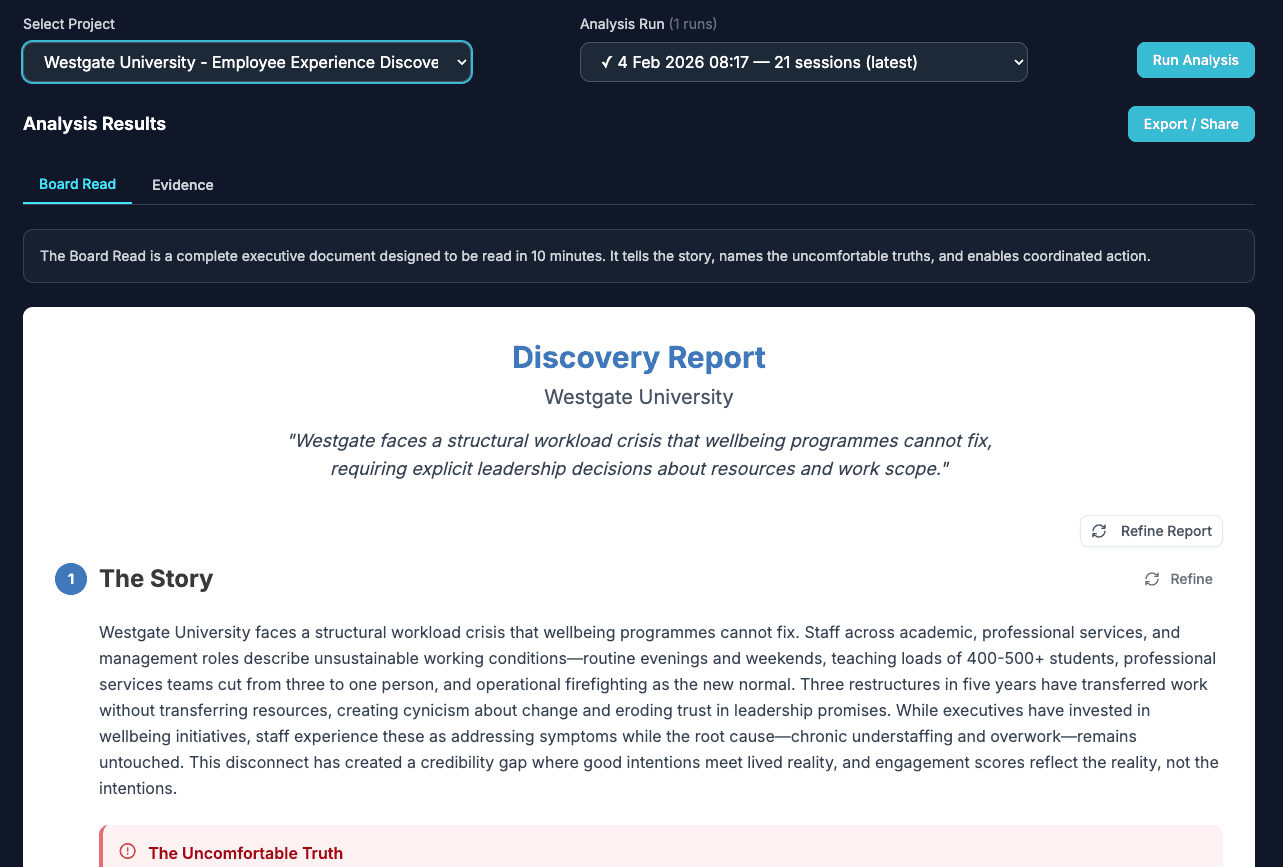
But beneath that simplicity sits a sophisticated analytical pipeline. Eleven specialist AI agents working in structured sequence. An evidence architecture that traces every finding to actual quotes. A verification layer that challenges its own conclusions. An AI query portal that lets you ask follow-up questions against the synthesised data at any point after delivery. And full editing and refinement controls that keep the consultant in charge of every output.
This tension between simplicity and sophistication is deliberate. It reflects a principle I've carried through 30 years of data and analytics consulting: complexity should serve the user, not burden them. If you need to understand the methodology, it's transparent and auditable. If you just need the output, that works too.
Early stage, learning fast
We're still early. I say that openly. Every demo teaches me something new about what matters most to the people who'll use this platform day to day. The feedback has confirmed core assumptions: purpose-driven analysis matters, consultants want control, speed without sacrificing rigour is non-negotiable. It has also surfaced things I hadn't anticipated, particularly the strength of demand for white labelling and the power of the hybrid model as a differentiator.
What I can say with confidence is that the reactions are real. People aren't being polite. They're asking when they can start. They're asking about branding. They're booking follow-up meetings. That tells me we're solving a problem that actually exists, in a way that actually works.
See it for yourself
If you're a consultant spending weeks on stakeholder discovery, or if you lead an internal team that needs to listen to your organisation at scale, I'd like to show you what we've built.
Book a 30-minute demo to see the full platform, or try the short sample voice interview to experience it yourself. No commitment, no sales pitch. Just a look at what AI-assisted stakeholder discovery actually looks like in practice.
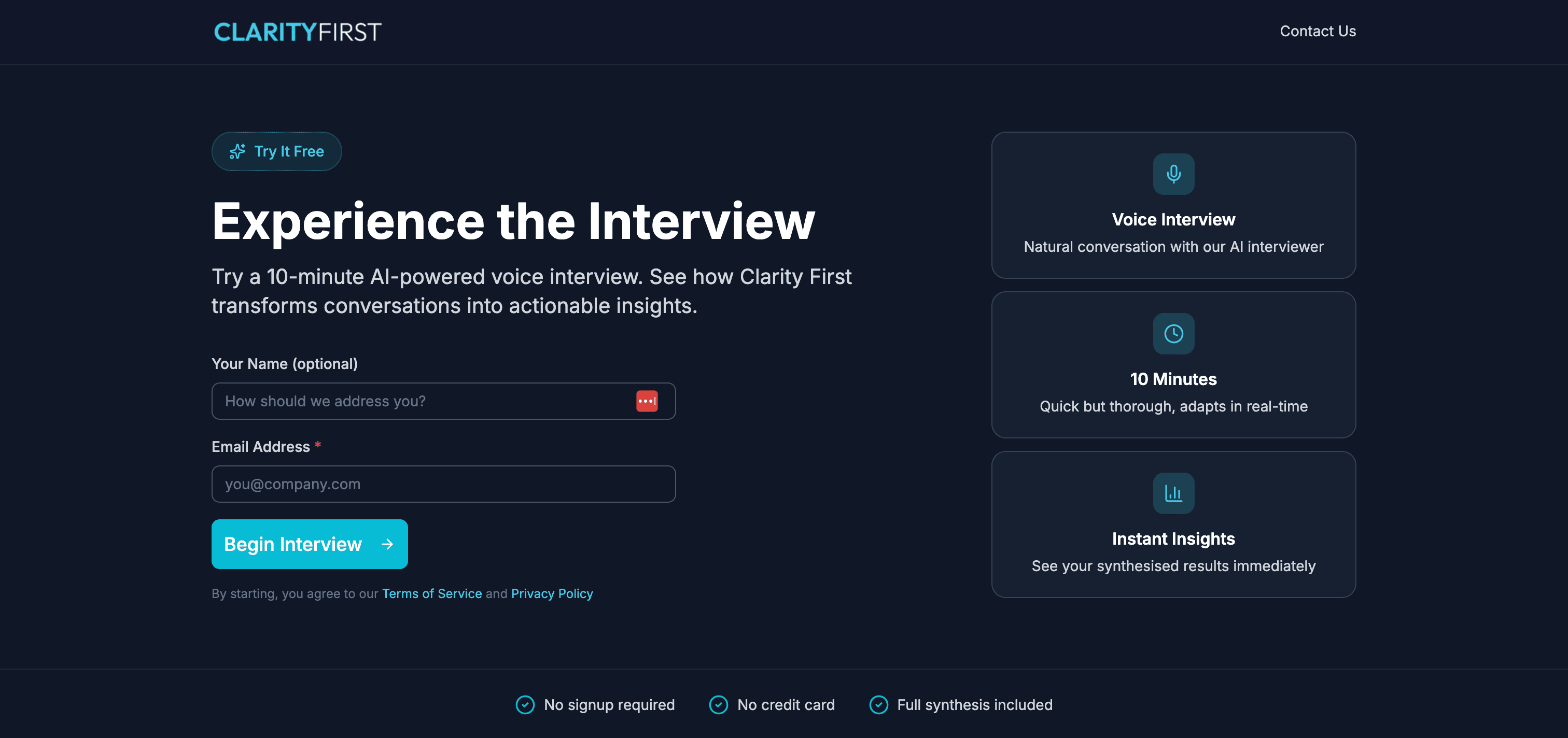
Ready to try it yourself?
Take a short sample interview, about five minutes. You can stop whenever you like, no account needed.
Try the voice demo