
How Clarity First Works: AI-Assisted Discovery That Doesn't Cut Corners
Structured stakeholder discovery used to require weeks of interviews, days of synthesis, and budgets that most organisations couldn't justify. Clarity First changes the economics without sacrificing the rigour.
The discovery problem
Every significant decision benefits from understanding the landscape first. What do stakeholders actually think? Where are the tensions? What's being assumed that shouldn't be?
The traditional approach works: schedule interviews, ask good questions, listen carefully, synthesise findings. Consultants have done this for decades, and when it's done well, it's invaluable.
But there are constraints.
Time. Scheduling alone can stretch discovery across weeks. Twenty-five interviews, each requiring coordination, preparation and follow-up. By the time findings are ready, the window for action has often narrowed.
Cost. Senior people running interviews, taking notes, synthesising patterns. The day rates add up quickly. For a large transformation programme, the investment is justified. For a mid-market company trying to understand whether they're ready for AI, or where their customer experience is breaking down, it's often out of reach.
Consistency. The quality of discovery depends heavily on who's doing it. Some consultants surface insights others would miss. Some follow a script and capture surface-level responses. The methodology varies. The depth varies.
These constraints mean that many organisations skip discovery entirely, or compress it into something too shallow to be useful. They move straight to solutions because they can't afford the time or cost of understanding first.
Clarity First exists to change that equation.
What Clarity First actually does
Clarity First is an AI-assisted discovery platform. It runs structured conversations with stakeholders — through AI or consultant-led interviews — and synthesises findings across all of them.
Here's what happens:
1. You define the discovery scope
Choose a framework (AI Readiness, Data Strategy, Customer Experience, or build your own) and configure it for your context. Set the company profile, the objectives, what's in scope and what's out.
2. Stakeholders complete interviews
Each participant receives a link. No login required, no app to install. They have a conversation — either speaking naturally or typing — that typically takes 15-25 minutes.
The conversation isn't a rigid questionnaire. It's adaptive. The system follows threads, asks follow-up questions, probes for specifics. "You mentioned friction in the approval process — can you tell me more about that?" "When you say the data isn't trusted, what makes you say that?"
3. The system synthesises across all interviews
This is where it gets interesting. After interviews are complete, Clarity First runs a multi-agent analysis pipeline:
- Interview analysis extracts structured findings from each conversation: themes, quotes, sentiment, specific examples
- Pattern detection looks across all interviews to identify what's consistent, what's contested, and what's missing
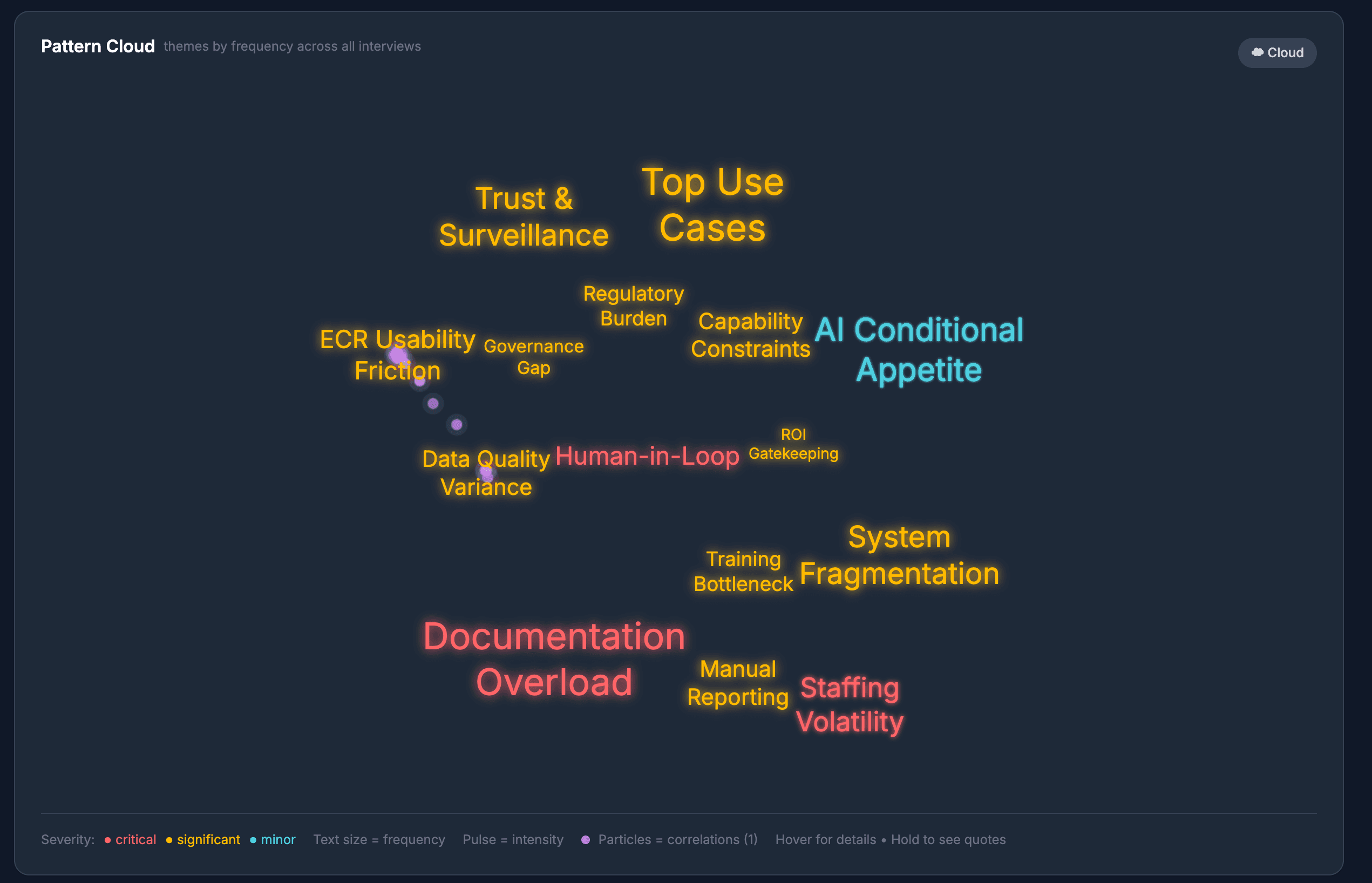
- Organisational analysis examines perception gaps between functions, seniority levels, and departments
- Synthesis pulls everything together into findings, recommendations, and an executive summary
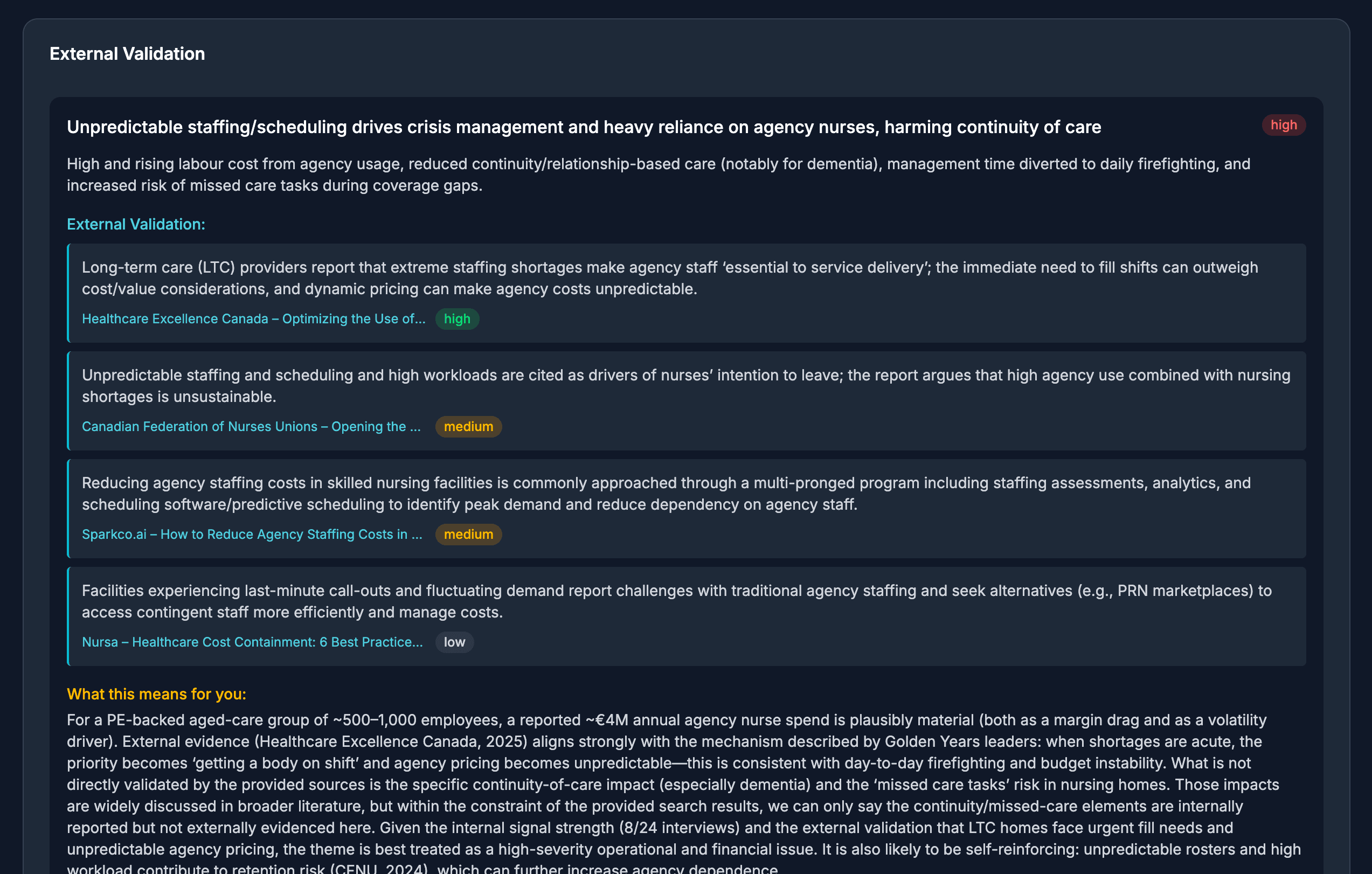
- External validation checks claims against external evidence where available
- Verification tests conclusions for consistency and flags areas of uncertainty
The output isn't a transcript dump. It's structured insight: what matters, why it matters, and what the evidence shows.
4. You get clarity
The dashboard shows patterns, priorities, and perceptions — grounded in what stakeholders actually said. Key quotes are attributed. Areas of agreement and disagreement are visible. You can drill into individual interviews or zoom out to the big picture.
Export to PDF, Word, or PowerPoint when you need to share findings with leadership or clients.
The methodology: Socratic, not scripted
Most survey tools ask fixed questions and aggregate responses. That approach has its place, but it misses the nuance that makes discovery valuable.
Clarity First uses a Socratic approach. The system doesn't just collect answers; it has conversations. When someone says something interesting, it follows that thread. When an answer is vague, it asks for specifics. When there's an apparent contradiction, it probes.
This matters because the most valuable insights often emerge from follow-up questions. "We have data quality issues" is less useful than "The sales team doesn't trust the pipeline numbers because they're updated manually and often two weeks out of date."
The conversation adapts based on what's been covered. If someone has already addressed a topic thoroughly, the system moves on. If there's a gap, it circles back. The goal is coverage and depth, not checking boxes.
Multi-agent synthesis: why it matters
A single AI model summarising transcripts would be faster, but it wouldn't be good enough. Clarity First uses specialised agents, each focused on a different aspect of analysis.
Why multiple agents?
Different analytical tasks require different approaches. Extracting structured data from a conversation is different from detecting patterns across thirty conversations. Identifying organisational dynamics is different from writing an executive summary. By separating these tasks, each can be optimised for its purpose.
The agent pipeline:
- Interview Analyst — Processes each conversation to extract themes, quotes, examples, and structured findings
- Pattern Detector — Looks across all interviews to identify frequency patterns, correlations, and gaps
- Organisational Analyst — Examines perception differences between groups, cultural signals, and change readiness
- Synthesiser — Creates the executive summary, key findings, and recommendations
- Research Agent — Validates claims against external sources where relevant
- Verification Agent — Tests conclusions for consistency, flags potential issues, and triggers re-analysis if needed
This isn't AI replacing human judgement. It's AI handling the parts that don't require human judgement — the transcription, the structured extraction, the cross-referencing — so that human attention can focus on interpretation and action.
What you see: the outputs
After synthesis completes, you have access to:
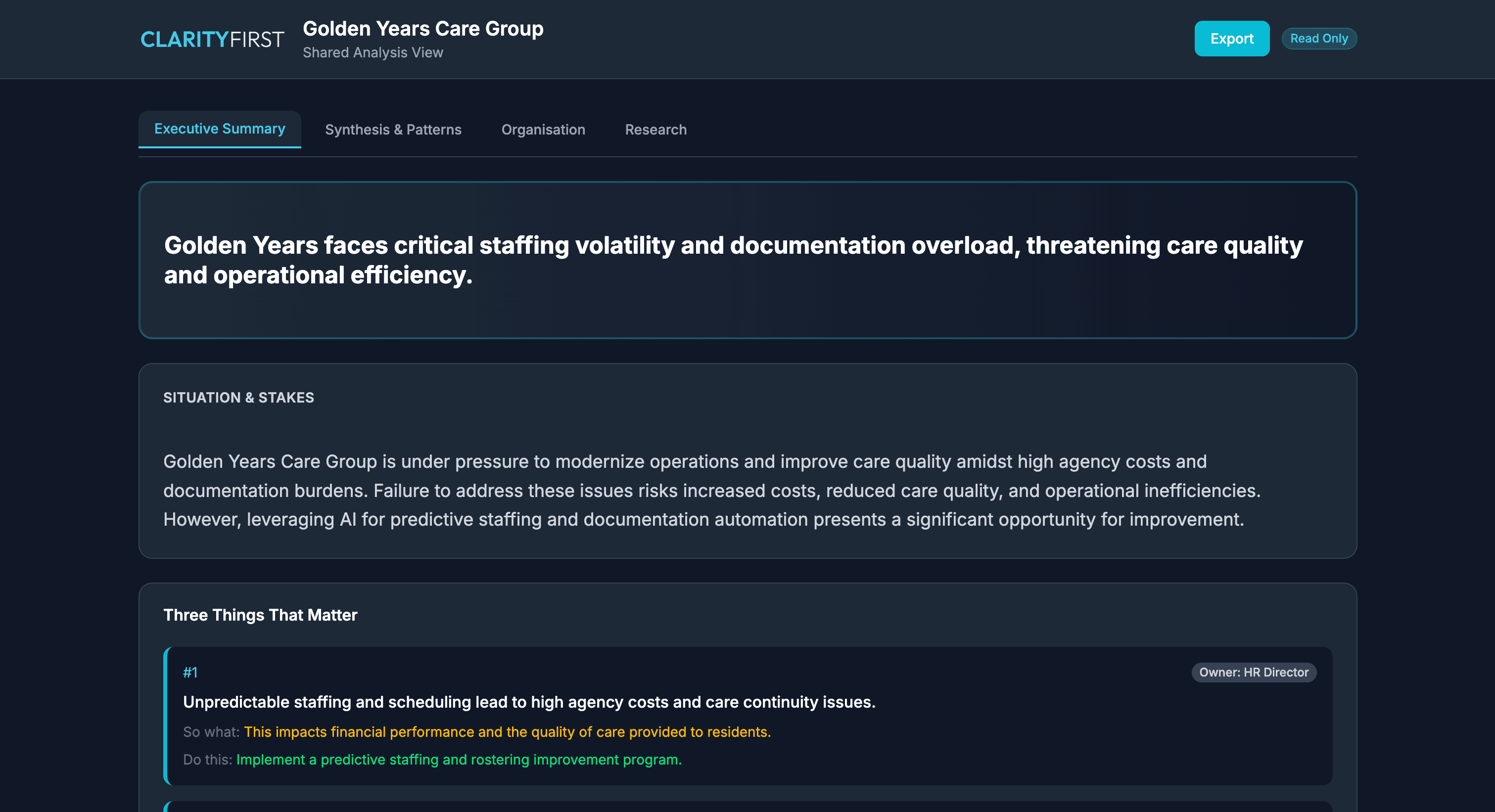
Executive Summary
The big picture. What are the three things that matter most? What should leadership know? Written in clear prose, not bullet-point soup.
Key Findings
Detailed findings organised by theme, with supporting evidence and attributed quotes. Each finding includes the strength of evidence (how many people mentioned it, how consistently).
Pattern Analysis
What themes appeared most frequently? Where was there strong agreement? Where was there disagreement or contradiction? Visual representation of patterns across all interviews.
Organisational Insights
Perception gaps between departments, functions, or seniority levels. Cultural signals. Change readiness indicators. The things that are often invisible from any single vantage point.
External Validation
Where claims could be checked against external evidence, what did we find? Industry benchmarks, market data, published research that supports or challenges the internal perspective.
Individual Interviews
Full access to each conversation, the extracted findings, and how they contributed to the overall synthesis. Nothing is hidden in a black box.
Who Clarity First is for
Consultants and advisory firms
Run discovery faster without sacrificing depth. Include more stakeholders than manual interviews would allow. Deliver structured findings with clear evidence trails. Spend your time on interpretation and recommendations rather than note-taking and synthesis.
In-house strategy and transformation teams
Gather perspectives systematically before making recommendations. Hear from people across the organisation, not just whoever's loudest or most senior. Build alignment by giving people a voice in the process.
Product and CX teams
Understand what customers and internal stakeholders actually think. Identify friction points, unmet needs, and perception gaps. Ground product decisions in evidence rather than assumptions.
Leadership teams considering significant changes
Before committing resources, understand the landscape. What do people think about the proposed direction? Where's the alignment, where's the resistance? What concerns might not surface in a town hall?
What Clarity First doesn't do
It doesn't make decisions for you. The platform surfaces insight; humans decide what to do with it. Interpretation, judgement, and action remain your responsibility.
It doesn't replace expertise. Understanding stakeholder perspectives is necessary but not sufficient. You still need domain knowledge, strategic thinking, and the ability to design interventions. Clarity First accelerates the understanding; it doesn't substitute for the expertise.
It doesn't guarantee agreement. Sometimes discovery reveals that stakeholders genuinely disagree. That's valuable information, but it doesn't resolve itself. Clarity First shows you where the disagreements are; navigating them is human work.
It doesn't work magic with bad inputs. If you define the wrong scope, ask the wrong questions, or invite the wrong stakeholders, the output will reflect that. Garbage in, garbage out still applies.
The economics
Traditional discovery for 25 stakeholders might take 4-6 weeks and cost €15,000-30,000 in consulting fees. That's before synthesis and reporting.
Clarity First runs the same scope in days. The cost is a fraction of manual approaches. Not because it's cutting corners, but because AI handles the parts that don't require human judgement.
This changes what's possible. Discovery becomes viable for projects that couldn't justify it before. You can include more stakeholders without proportionally increasing cost. You can run discovery earlier in the process, when it's most valuable.
How it fits with existing work
Clarity First isn't trying to replace consultants or strategy teams. It's infrastructure that makes their work more effective.
For consultancies: Offer discovery as a standalone service or as the foundation for larger engagements. Deliver faster without hiring more analysts. Differentiate on depth and rigour rather than competing on price.
For in-house teams: Run discovery internally without external dependencies. Build a practice of evidence-based decision-making. Create alignment before initiatives launch rather than managing resistance after.
Alongside other tools: Clarity First focuses on stakeholder discovery. It complements (doesn't replace) survey tools, analytics platforms, and project management systems. Use it for the qualitative depth that quantitative tools can't provide.
Try it yourself
The best way to understand Clarity First is to experience it.
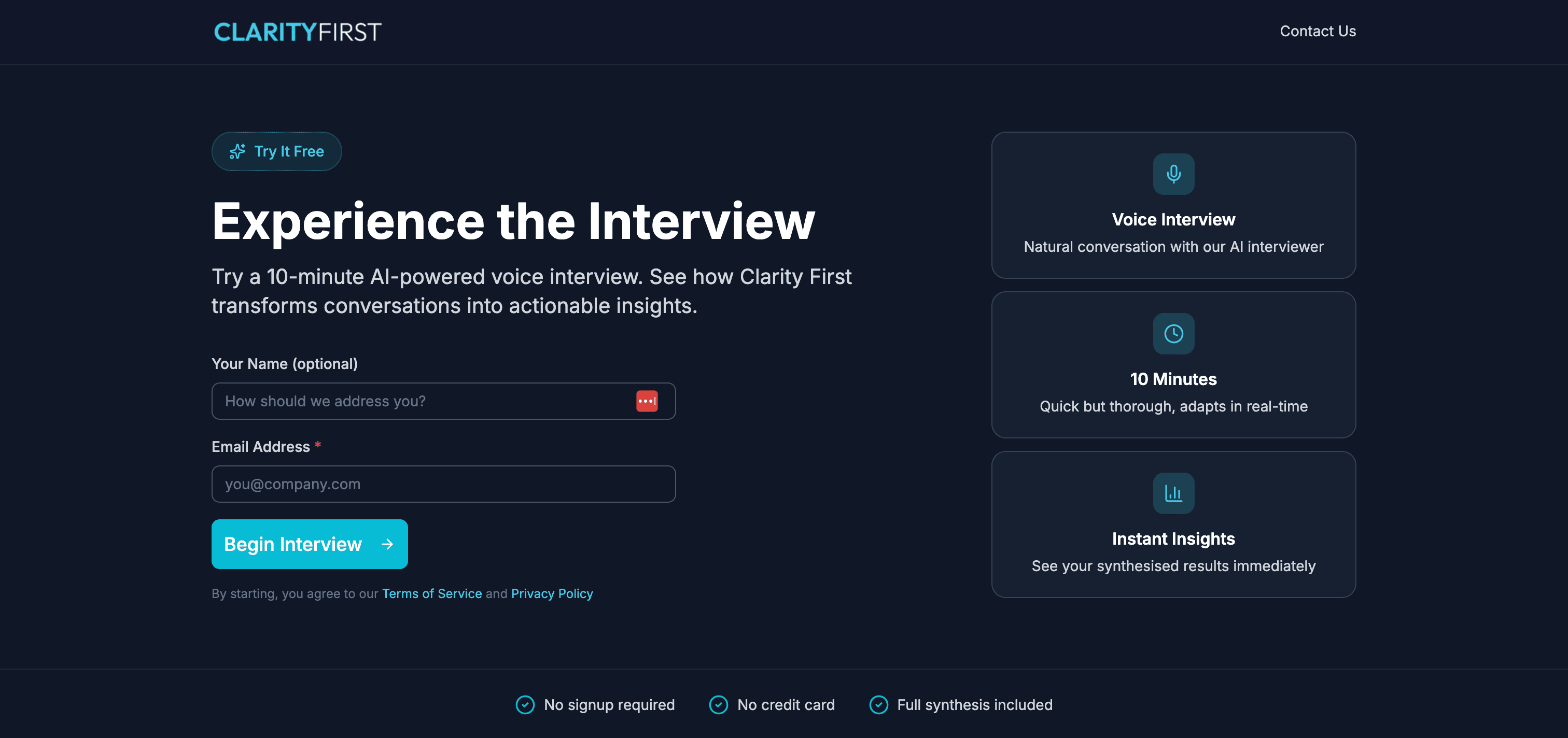
We offer a short sample voice interview, about five minutes, and you can stop any time. You'll see how the conversation adapts, how follow-up questions work, and what the synthesis outputs look like.
If it fits what you're trying to do, we can talk about how it would work for your specific context.
Summary
Clarity First is AI-assisted stakeholder discovery that maintains the rigour of traditional approaches while changing the economics.
- Adaptive conversations that probe for depth, not just collect answers
- Multi-agent synthesis that finds patterns across all interviews
- Structured outputs with clear evidence trails
- Days instead of weeks, at a fraction of the cost
Discovery shouldn't be a luxury. The organisations that understand before they act make better decisions. Clarity First makes that understanding accessible.
Ready to try it yourself?
Take a short sample interview, about five minutes. You can stop whenever you like, no account needed.
Try the voice demo